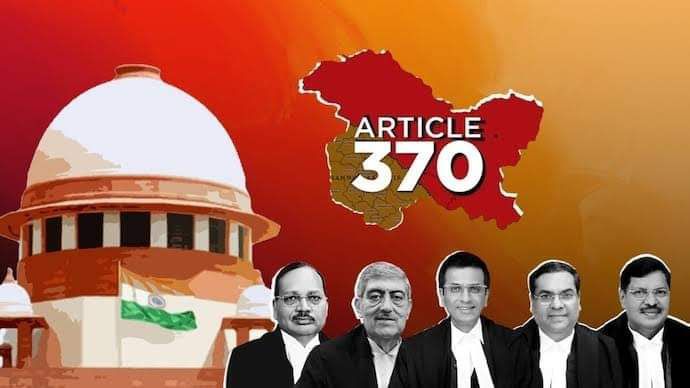
The Supreme Court Monday held the 2019 move by the Union government to abrogate Article 370, which gave special status to the erstwhile state of Jammu and Kashmir, as constitutionally valid.
A five-judge Constitution bench, presided by Chief Justice of India D Y Chandrachud and comprising Justices S K Kaul, Sanjiv Khanna, B R Gavai and Surya Kant, also directed the Centre for the restoration of statehood and for Legislative Assembly elections to be held.
The bench pronounced three judgments – one by the CJI for himself and Justices Gavai and Surya Kant, a concurring judgment by Justice Kaul and a third by Justice Khanna concurring with the other two rulings.
The State of Jammu and Kashmir does not retain any element of sovereignty after the execution of the Instrument of Accession (IoA) and the issuance of the Proclamation dated 25 November 1949, by which the Constitution of India was adopted. The State of Jammu and Kashmir does not have ‘internal sovereignty’, which is distinguishable from the powers and privileges enjoyed by other States in the country. Article 370 was a feature of asymmetric federalism and not sovereignty.
Challenge to Proclamations does not merit adjudication
The petitioners did not challenge the issuance of the Proclamations under Section 92 of the Jammu and Kashmir Constitution and Article 356 of the Indian Constitution until the special status of Jammu and Kashmir was abrogated. The challenge to the Proclamations does not merit adjudication because the principal challenge is to the actions which were taken after the Proclamation was issued.
The exercise of power by the President after the Proclamation under Article 356 is issued is subject to judicial review. The exercise of power by the President must have a reasonable nexus with the object of the Proclamation. The person challenging the exercise of power must prima facie establish that it is a mala fide or extraneous exercise of power. Once a prima facie case is made, the onus shifts to the Union to justify the exercise of such power;
Parliament’s power under Article 356(1)(b) cannot be restricted to law-making
The power of Parliament under Article 356(1)(b) to exercise the powers of the Legislature of the State cannot be restricted to law-making power, thereby excluding non-law making power of the Legislature of the State. Such an interpretation would amount to reading in a limitation into the provision contrary to the text of the Article.
Article 370 was a temporary provisions
It can be garnered from the historical context for the inclusion of Article 370 and the placement of Article 370 in Part XXI of the Constitution that it is a temporary provision.
Power under Article 370(3) did not cease to exist upon dissolution of Constituent Assembly
The power under Article 370(3) did not cease to exist upon the dissolution of the Constituent Assembly of Jammu and Kashmir. When the Constituent Assembly was dissolved, only the transitional power recognised in the proviso to Article 370(3), which empowered the Constituent Assembly to make its recommendations, ceased to exist. It did not affect the power held by the President under Article 370(3).
Article 370 cannot be amended by exercise of power under Article 370(1)(d)
Article 370 cannot be amended by exercise of power under Article 370(1)(d). Recourse must have been taken to the procedure contemplated by Article 370(3) if Article 370 is to cease to operate or is to be amended or modified in its application to the State of Jammu and Kashmir. Paragraph 2 of CO 272, by which Article 370 was amended through Article 367, is ultra vires Article 370(1)(d) because it modifies Article 370, in effect, without following the procedure prescribed to modify Article 370. An interpretation clause cannot be used to bypass the procedure laid down for amendment.
President did not have to secure concurrence of Union or state governments
The exercise of power by the President under Article 370(1)(d) to issue CO 272 is not mala fide. The President, in exercise of power under Article 370(3), can unilaterally issue a notification that Article 370 ceases to exist. The President did not have to secure the concurrence of the Government of the State or Union Government acting on behalf of the State Government under the second proviso to Article 370(1)(d) while applying all the provisions of the Constitution to Jammu and Kashmir because such an exercise of power has the same effect as an exercise of power under Article 370(3) for which the concurrence or collaboration with the State Government was not required.
Applying all provisions of Constitution to Jammu and Kashmir valid
Paragraph 2 of CO 272 issued by the President in exercise of power under Article 370(1)(d) applying all the provisions of the Constitution of India to the State of Jammu and Kashmir is valid. Such an exercise of power is not mala fide merely because all the provisions were applied together without following a piece-meal approach.
President had power to declare that Article 370(3) ceases to operate without recommendation of Constituent Assembly
The President had the power to issue a notification declaring that Article 370(3) ceases to operate without the recommendation of the Constituent Assembly. The continuous exercise of power under Article 370(1) by the President indicates that the gradual process of constitutional integration was ongoing. The declaration issued by the President under Article 370(3) is a culmination of the process of integration and as such is a valid exercise of power. Thus, CO 273 is valid.
Constitution of India is a complete code for constitutional governance
The Constitution of India is a complete code for constitutional governance. Following the application of the Constitution of India in its entirety to the State of Jammu and Kashmir by CO 273, the Constitution of the State of Jammu and Kashmir is inoperative and is declared to have become redundant.
On forming Union Territories of Jammu and Kashmir, and Ladakh
Parliament’s exercise of power under first proviso to Article 3 under Proclamation valid
The views of the Legislature of the State under the first proviso to Article 3 are recommendatory. Thus, Parliament’s exercise of power under the first proviso to Article 3 under the Proclamation was valid and not mala fide.
Decision to carve out Union Territory of Ladakh valid
The Solicitor General stated that the statehood of Jammu and Kashmir will be restored (except for the carving out of the Union Territory of Ladakh). In view of the statement, we do not find it necessary to determine whether the reorganisation of the State of Jammu and Kashmir into two Union Territories of Ladakh and Jammu and Kashmir is permissible under Article 3. However, we uphold the validity of the decision to carve out the Union Territory of Ladakh in view of Article 3(a) read with Explanation I, which permits forming a Union Territory by separation of a territory from any State.
Conduct elections by September 30, 2024
We direct that steps shall be taken by the Election Commission of India to conduct elections to the Legislative Assembly of Jammu and Kashmir, constituted under Section 14 of the Reorganisation Act, by 30 September 2024. Restoration of statehood shall take place at the earliest and as soon as possible.
High Court Chief Justices Have No Power To Frame Rules On Post-Retiral Benefits To Former Judges : Supreme Court
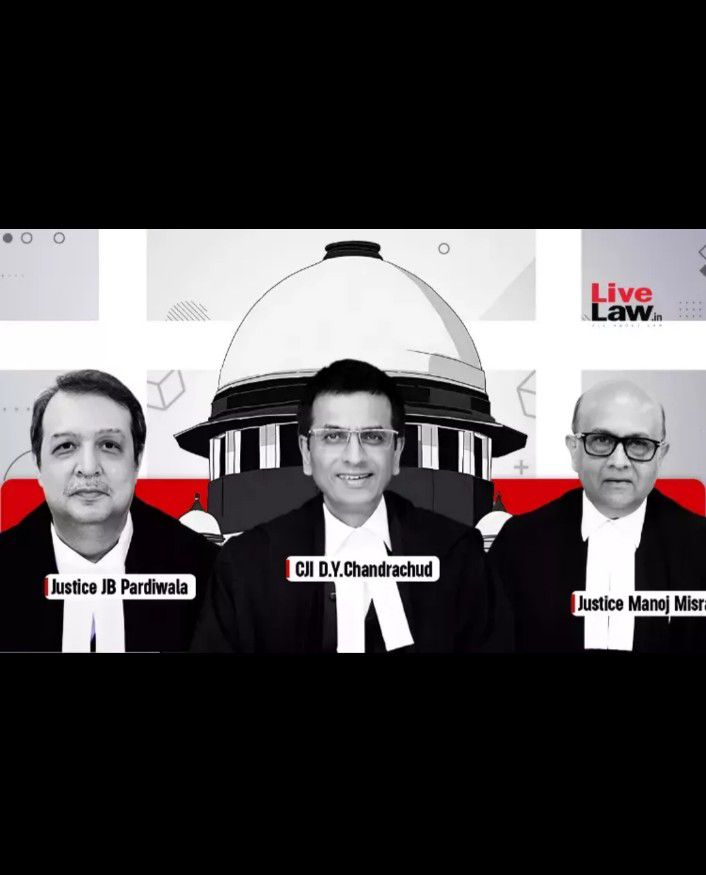
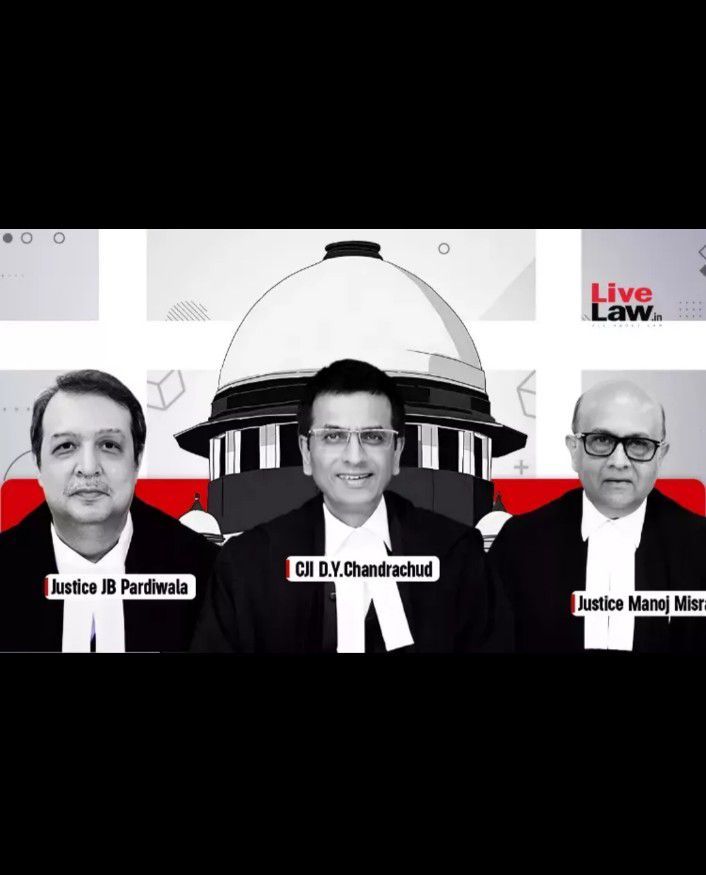
The bench comprising the Chief Justice of India, DY Chandrachud and Justices JB Pardiwala and Manoj Misra observed that policymaking involves taking into consideration several factors including local and financial aspects. The High Court under the ambit of its judicial powers cannot “browbeat the State Government to notify Rules proposed by the Chief Justice”, the Top Court stated.
Court seeks details on lumpy skin disease control measures
The new Indian Express News Service | Published: 02nd August 2023 07:42 AM
HYDERABAD: A division bench of the Telangana High Court, led by Chief Justice Alok Aradhe and Justice T. Vinod Kumar, on Tuesday expressed its dissatisfaction with the lack of specific details about measures taken to control the outbreak of Lumpy Skin Disease (LSD) in cattle.
The court directed the State government and Animal Husbandry Department authorities to submit an affidavit explaining the steps they have implemented to curb the spread of the disease.
The PIL, originally a letter written by Rayapuram Moulaiah, a law student from the Jogulamba-Gadwal district, was taken up by the division bench. Special Government Pleader (SGP) A Sanjeev Kumar assured the court that the State government has been undertaking all necessary actions to control the LSD outbreak.
The court noted that it lacked crucial details regarding the methods employed to control LSD, including any vaccination initiatives to prevent and manage the disease. In response, the SGP representing the State requested a four-week extension to submit a comprehensive and detailed affidavit.
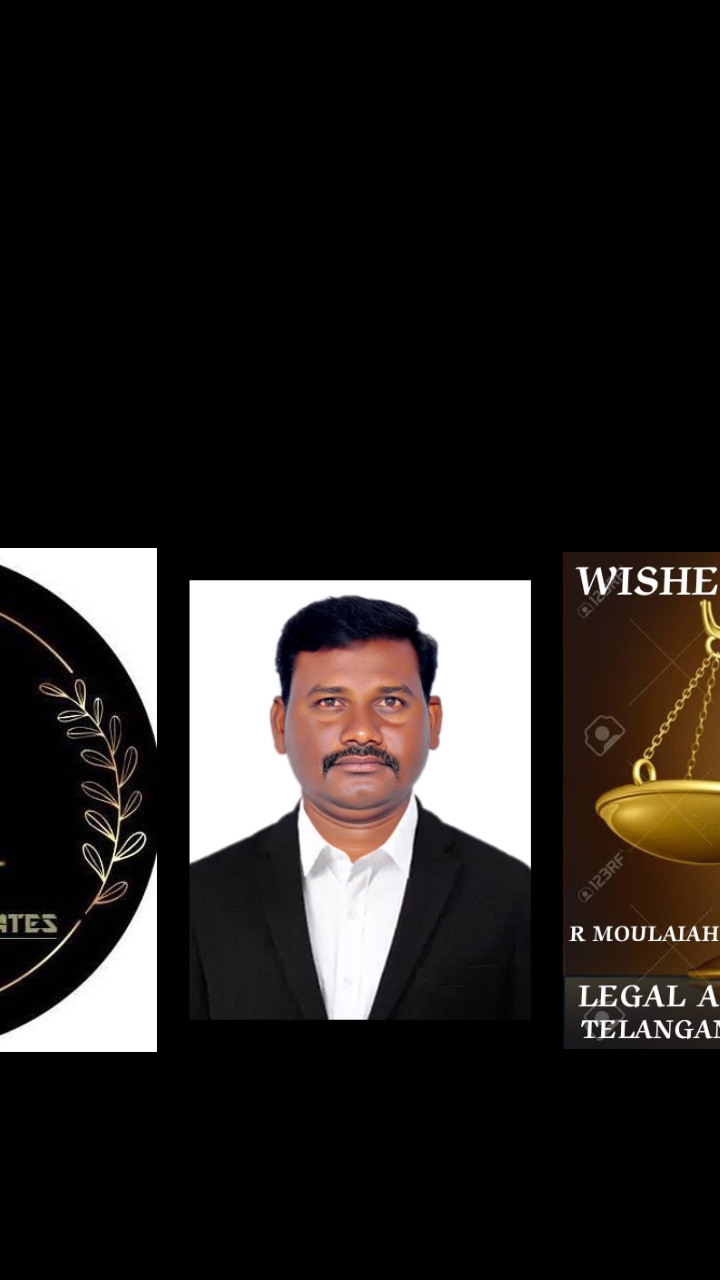
HIS LIFE AMBITION TO SOLVE OF PUBLIC INTEREST LITIGATION: Moulaiah Naidu is passionate about PIL. An intense fascination with PIL drove him to pursue a career as a Legal Assistance. He has started his Business Legal Writing and Drafting under the registration number “Law Firm”Reg. No.3 of 2022 At M.Nagar TS. The objective of the Firm:Legal Assistance – is drafting legal petitions, appeals, etc. and a wide variety of legal petitions requests, etc., seeking justice for innocent people.
Through our organisation, we are carrying out the following programs and implementing legal aspects with a humanitarian perspective to bring justice to the people in the public interest.
Our firm provides legal services for Human Rights Violation Petitions, Appeals and Civil Criminal Petitions of High Court Writ etc.
Civil disputes, Land Disputes, Non-agricultural land issues and legal drafting for various types of civil disputes.
Our organisation always dedicates legal writings to the innocent masses, tribal, Dalit, minority, underprivileged, and socio-economic lifestyle changes as our contribution.
Moulaiah Naidu gained a reputation as a “Man of the People” because of his passion for equal justice for individuals from all walks of life and the services he provided to the populace. He becomes from “Law Firm” and continued his unwavering service.
R Moulaiah Naidu Legal Associate who filed the first ever “PIL” against Lumpy Skin Disease in India (Lokayukta Complaint No.1499 OF 2022 By the Public Interest Litigation by his own office at the Law Firm)-Directions Orders were issued on the same day.
Similarly, he, has filed a case in the TS HRC in Hyd, by the “PIL” was filed, and the Hon’ble court order was granted immediately after hearing the case on the same day as the case was filed realizing the seriousness of lumpy virus,SR No.4480 OF 2022 IN HRC Case No. 4493 OF 2022 By the Public Interest Litigation.)-
And he was not fed up with all this and declared a legal battle against the central gov on the Lampy virus issues and served a notice to the central gov against the Lampy Virus. Because by October 2022, one lakh and fifty thousand animals will die across India.
R MOULAIAH NAIDU LEGAL ASSOCIATES GADWAL TELANGANA 9573436500
Hey,
WhatsApp Business is an app built for small business owners. With the app, you can create a business profile and easily connect with customers.
Get it for free at https://www.whatsapp.com/business/
In an important ruling, the Supreme Court on Thursday held that direct evidence of demand or acceptance of bribe is not necessary to convict a public servant under the Prevention of Corruption Act and that the such fact can be proved through circumstantial evidence. Hon’ble Supreme Court of India Criminal appeal no. 1669 OF 2009 Judgment date 15 Dec. 2022
Central Government Act
Section 14 in The Prevention of Corruption Act, 1988
Habitual committing of offence under sections 8, 9 and 12.—Whoever habitually commits,—
(a) an offence punishable under section 8 or section 9; or
(b) an offence punishble under section 12, shall be punishable with imprisonment for a term which shall be not less than two years but which may extend to seven years and shall also be liable to fine.
What is the Difference Between a Lawyer and an Advocate? – Lawyer Vs Advocate
Staff Desk
Dec 2, 2022 1,590 4 mins
To understand what constitutes a lawyer in India, as well as what constitutes an advocate in India, it is necessary to understand ‘Lawyer Vs Advocate’ in order to understand what constitutes a lawyer.
It is not uncommon for advocates and lawyers to be used interchangeably. In addition, it is not uncommon for them to be used in the same sentence at the same time. Even though there are similarities between the two of them, there are also some significant differences. Lawyers and advocates communicate with each other in different ways, depending on the situation.
What Does an Advocate Do?
Advocates are legal experts with specialized training in the law who are trained to represent their clients in court. In this case, it can be a person or an entity such as a company, a bank, etc. This program includes a professional certification from an accredited law program and a license to practice law in India as part of its requirements. As soon as an advocate passes the Bar Council of India exam, he or she is granted the license to practice.
What Does a Lawyer Do?
A lawyer is a legal professional who has studied the law in order to become a lawyer. A lawyer is a person who has a legal education and is a lawyer, a counsellor, an advisor, a solicitor, or a barrister. In order to practice law, a candidate must have completed the prescribed course of study and earned the necessary qualifications in order to become a lawyer.
The ability to thoroughly understand the laws that govern a country is one of the most significant skills that a lawyer possesses. An attorney’s job is to make sure that their clients are treated with the justice they deserve. This is why they get into law and study and research the law in order to do so. One of the most important duties of a lawyer services is to advise clients on their constitutional rights and responsibilities when it comes to their legal matters. As well as drafting legal documents for businesses as well as individuals, it is also possible for a lawyer to draft legal drafts and documents for both groups.
The Indian law system is based on the common law system. The fundamental structure of the country is very similar to that of England in terms of its fundamental principles. The study of law in India is conducted through a five-year program (integrated BA-LLB or BBA-LLB) which is conducted by a university.
As a result of completing this course, one can appear for the All India Bar Exam. This exam is administered on an annual basis by the Bar Council of India after completing this course. As an advocate, if you pass the exam and become a member of the Bar Council of India, you will be able to practice law in any Indian court.
Lawyer Vs Advocate
Lawyer
AdvocateThe term ‘lawyer’ is very general in nature, and is often used to describe anyone involved in the legal profession, whether they are solicitors, barristers, or attorneys.
As an alternative, an advocate is a professional who represents the client in a court of law on behalf of the client. This can be either seeking compensation for the client or releasing the client based on the facts of the case.If a lawyer/law graduate wishes to practice in a court of law, they will need to be enrolled in a state bar council and clear the All India Bar Exam.
When a person has passed the bar exam and becomes a member of the state bar council, they can refer to themselves as an advocate. They can appear for clients in court after having passed the bar exam.
Since they just graduated from law school, lawyers are less experienced than advocates. Since they have not yet acquired the necessary experience to be able to represent clients, they are unable to do so.
In general, they are considered to be more experienced than lawyers. This is because they have had the opportunity to practice their profession in a variety of different judicial settings throughout their careerThe duties and responsibilities of a lawyer involve giving legal advice to their clients but they cannot represent them in the court of law.
As advocates possess a wide range of knowledge, experience and skills regarding legal matters, they are heavily involved in representing their clients most of the time, and they strive to achieve the best result for their clients while pleading on their behalf.
It is true that the terms lawyer and advocate are two different terms that are often used interchangeably in the Indian legal system. The difference between an advocate and a lawyer is that the advocate is a licensed professional who has the right to practice law. Lawyers can only provide legal assistance to clients, while attorneys can represent clients in court. Generally speaking, anyone who has a legal education is considered to be a lawyer. However, if you wish to become an advocate in India, you must pass the All India Bar Examination in order to become one.
Conclusion
It is important to keep in mind that in India, the difference between a lawyer and an advocate is that a lawyer cannot appear in any court of law. There is no way he can argue a case in front of the court. As far as presenting a case in court is concerned, only an advocate has the right to do so. Advocates and lawyers have different jurisdictions of work based on the fact that lawyers are able to provide legal advice to their clients and prepare legal documents, but they will not be able to represent a case in court until they have passed the All India Bar Examination.
While still in school, every aspiring lawyer hopes to join one of India’s premier law firms after graduation. They may…
Subscribe to our newsletter
Stay up to date in tax, compliance and legal developments
Name
Email ID
Submit
Categories
About Us
Vakilsearch is India’s largest provider of legal, secretarial, accounting, and compliance services. We have successfully worked with over 5 lakh customers, and have now registered over 10% of all the companies registered in India.











 RAYAPURAM MOULAIAH NAIDU LEGAL ASSOCIATE